







Service visibility
- Common gap
- Separate dashboards for each part of the application.
- Good practice
- One view of the service and its dependencies.
 Observability Check
Disconnected tools and alerts without clear owners make finding the cause harder. Take our free five-minute Observability Check to identify gaps in your setup and see what to improve first.
 Gold Partner
 Technology partner
 Developed by Swiss Digital Network
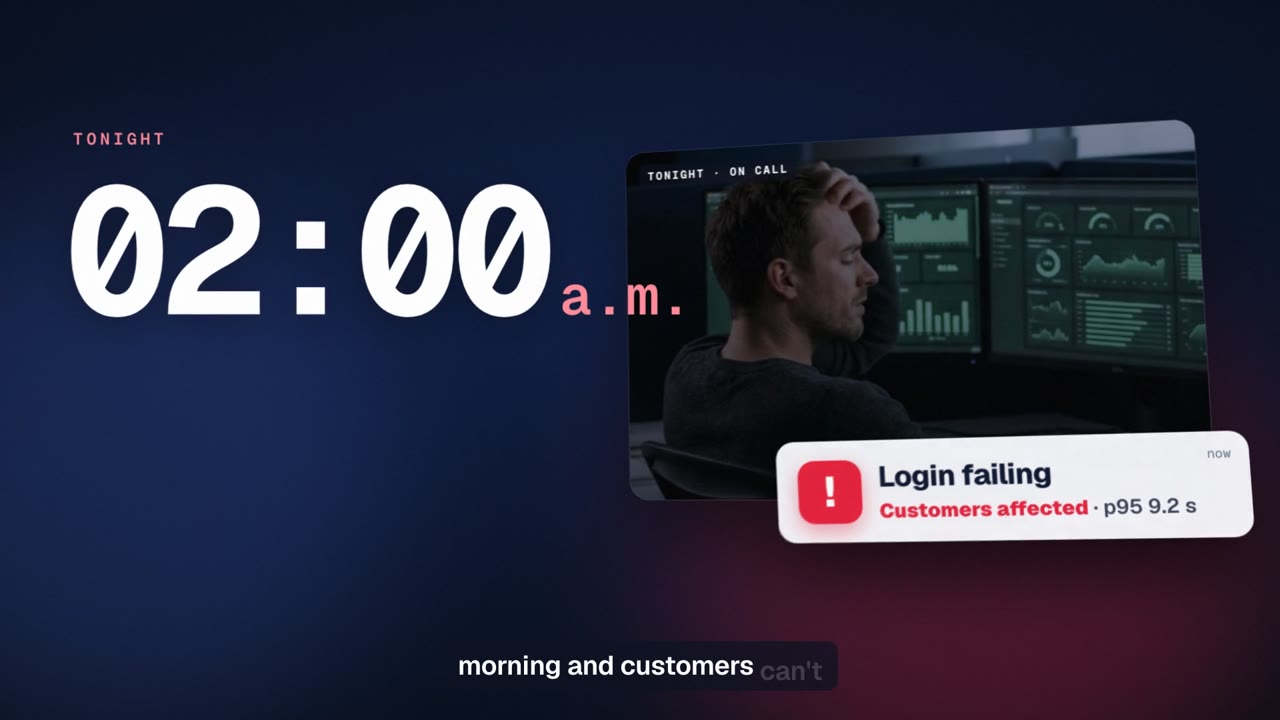
Watch one failed login play out twice: first with every team checking its own tool, then with the evidence connected in one place.
Illustrative replay. Without observability, the on-call responder is paged at 02:47, eight teams join and each checks its own tool. After 2 hours 22 minutes and 12 people, the cause turns out to be an external SMS provider timeout. With observability, the alert already points to the failing span. One trace shows the SMS gateway timing out after 6.2 seconds, the identity owner is paged, and logins recover after 4 minutes with 2 people.
Illustrative example. Observability connects the evidence; your engineers still investigate and act.
Why Swiss Digital Network
Trusted by
Public Swiss Digital Network references





© PostFinance Ltd 2024. All rights reserved.
Check four things your team needs to find the cause of an incident.
See your score and download your five-page report as soon as you finish. Get priorities, suggested owners and a way to check each action is done.
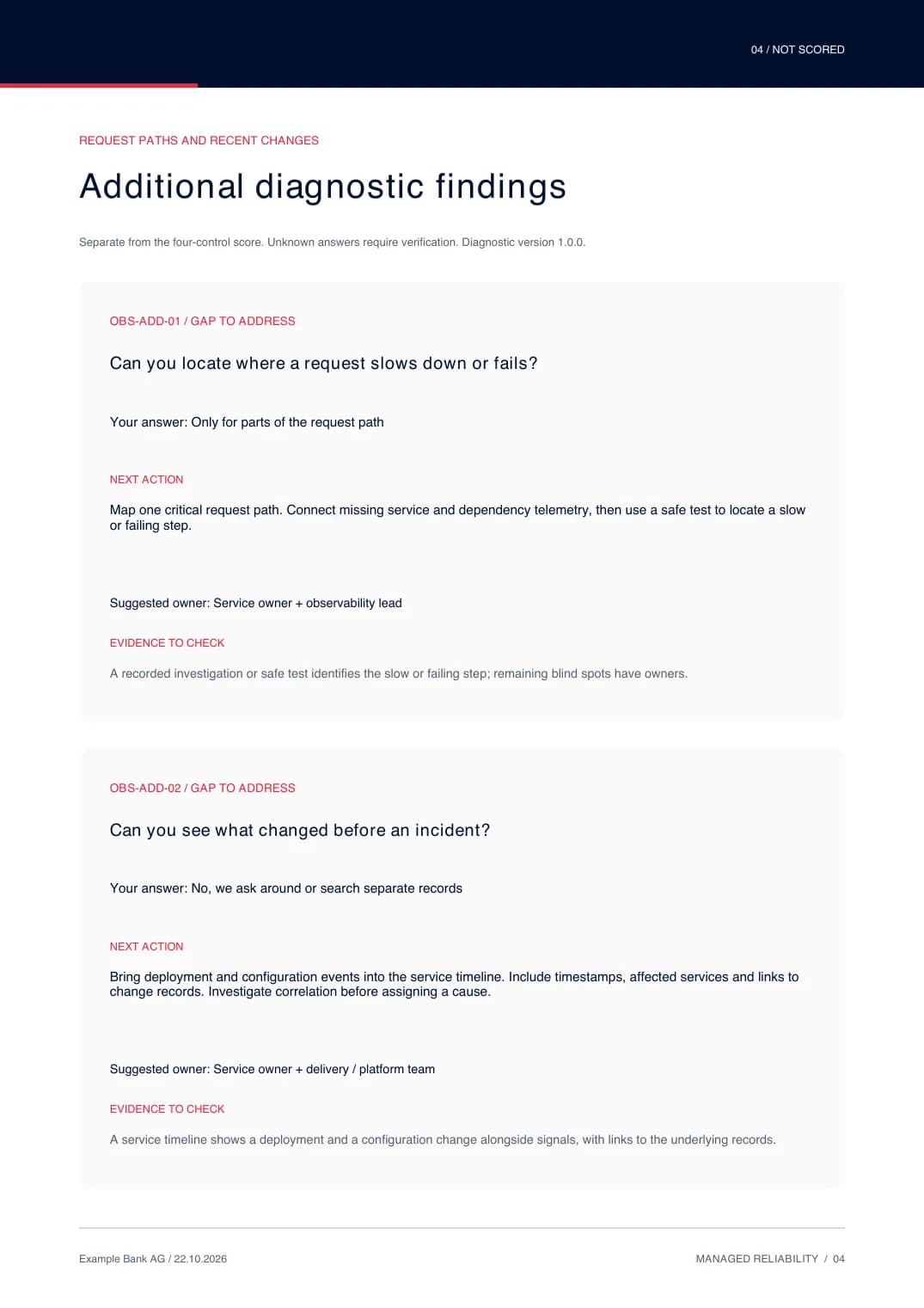
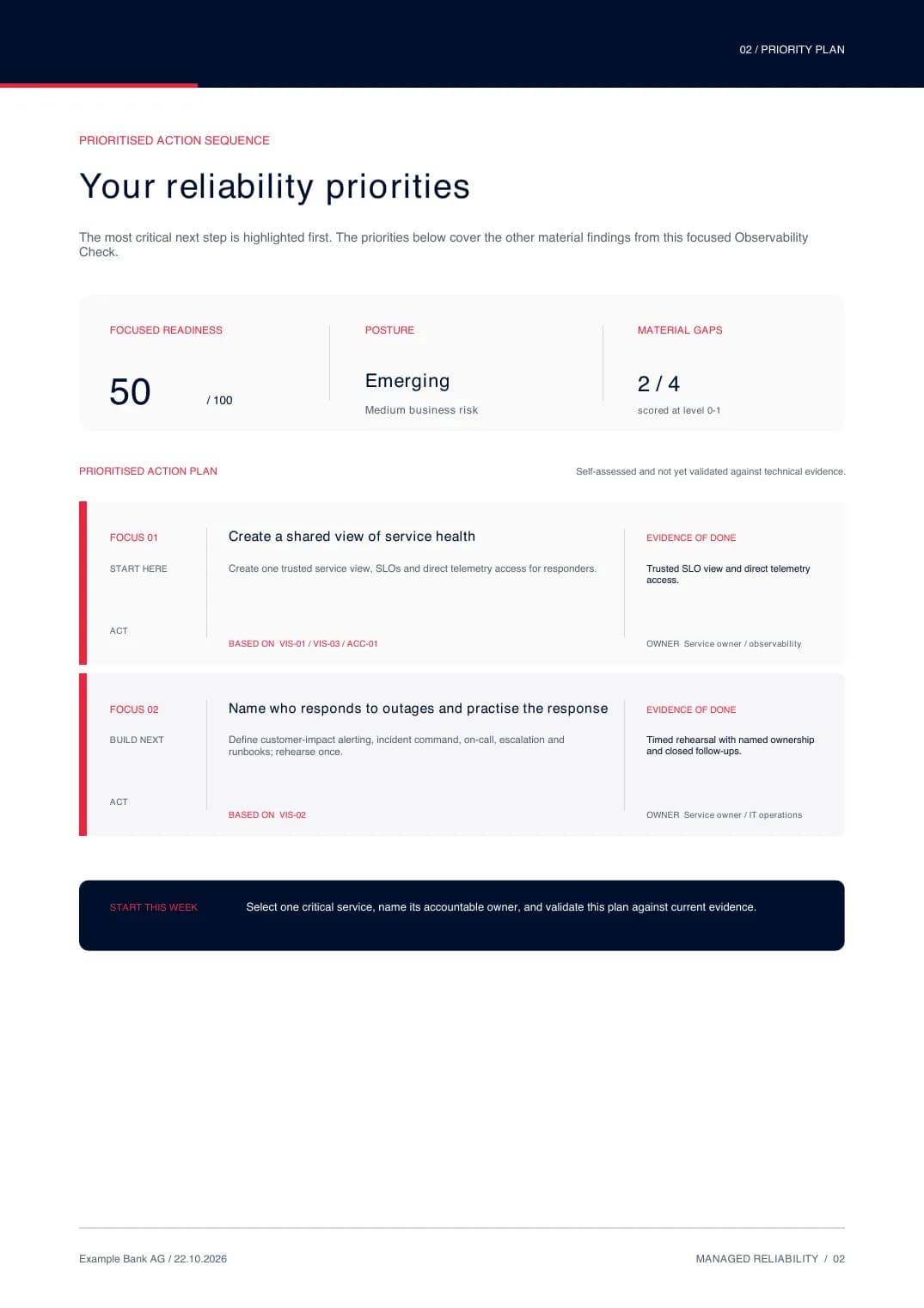
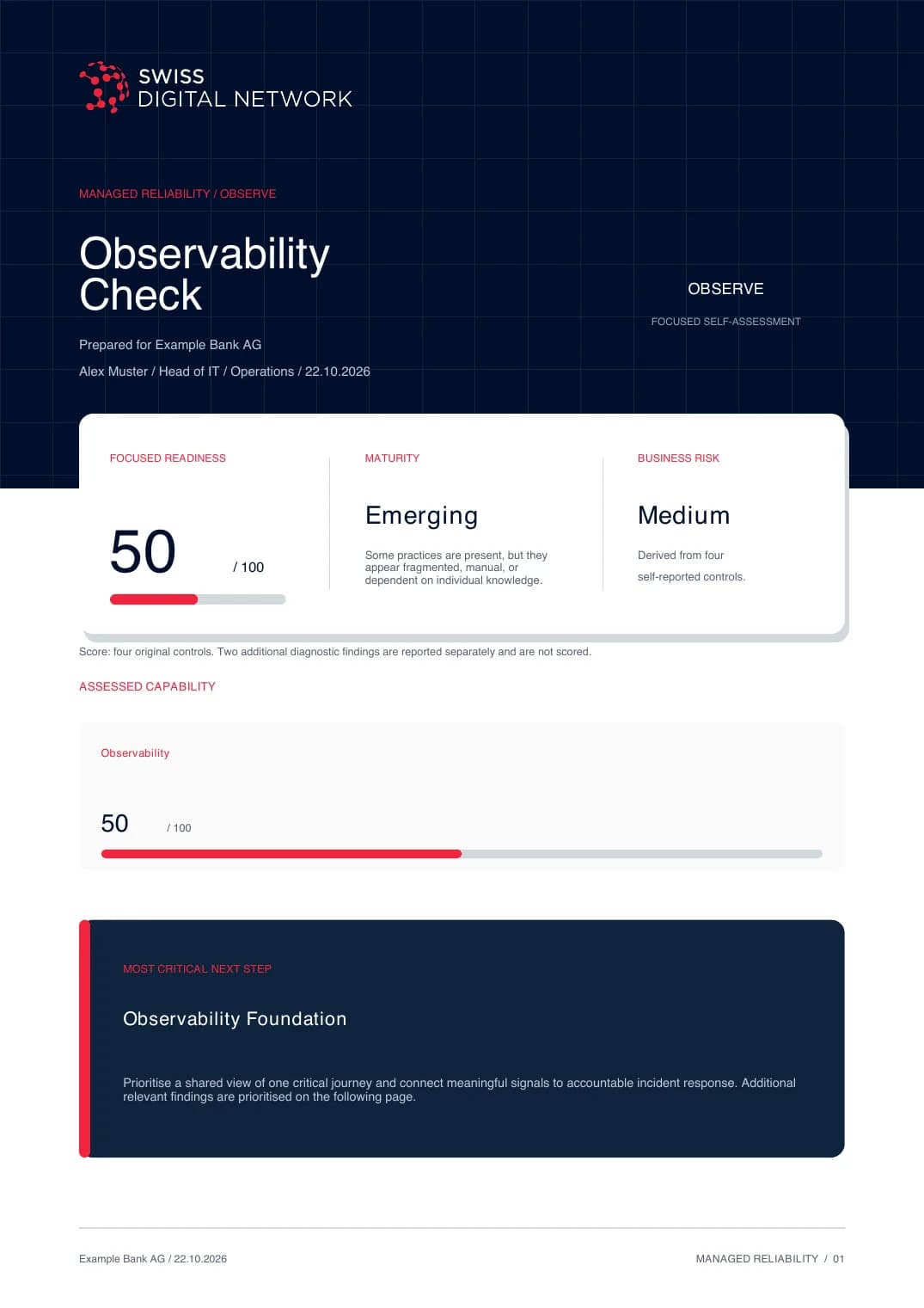 Sample report
Keep the work in-house, or let Swiss Digital Network set up and maintain observability for your critical application.
| The work | Build internally | Managed Observability |
|---|---|---|
| Specialist skills | Hire or grow people who know telemetry pipelines, Grafana, alert design and SLOs. | Observability specialists work alongside your team from the first week. |
| Connect the evidence | Your team connects service context, metrics, logs and traces. | Specialists connect the signals for your agreed service scope. |
| Alerts and service targets | Your team defines service targets, tunes alerts and decides who responds. | We set up service targets and alerts tied to customer impact, with named responders. |
| Use it in an incident | Responders learn to find their way through the data under pressure. | Service views and runbooks are built so any responder can follow the evidence. |
| Keep it useful over time | Your team maintains the setup and reviews it as the application changes. | Ongoing maintenance and health reviews keep an agreed improvement backlog moving. |
| Cost and effort | Headcount, licences, integration work and maintenance all sit with you. | One scoped engagement for your agreed services, building on the tools you already have. |
| Best fit | You have the people and the time to build and run it yourselves. | You want results on one critical application without building a team first. |
Yes. The self-assessment, score and personalised report are free. You can use the findings with your own team, and there is no obligation to buy a service or book a meeting.
Choose one critical application you know well. Answer four scored questions about its observability, two diagnostic questions and one about your operating model. Allow around five minutes. No installation is required.
After the questions, we ask for your company and work email. Name and role are optional. We use your details to prepare your score and personalised report. The form explains contact about your result, and broader marketing updates are a separate, optional choice.
The result reflects your answers about current practices. It highlights possible gaps and suggested actions. Actual incident performance needs to be checked against your telemetry and experience. This is a self-assessment, not a technical audit or an external benchmark.